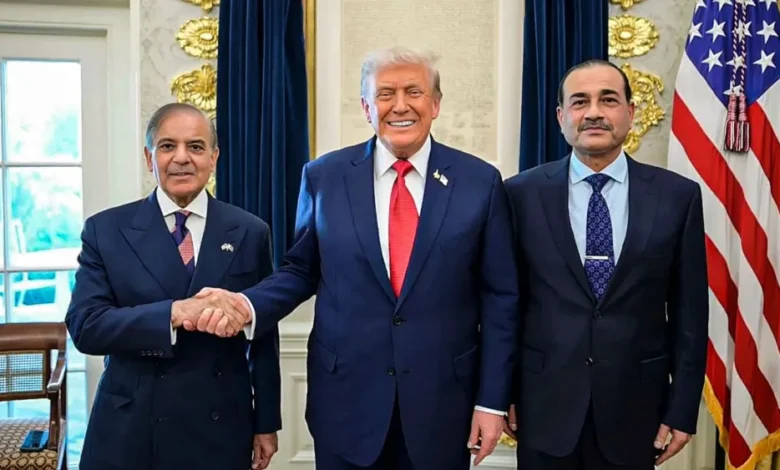
Asim Munir, Shehbaz Sharif “Great People”: Donald Trump’s High Praise and a Pledge to Broker Peace
On the sidelines of the ASEAN summit in Kuala Lumpur, the U.S. president hailed Pakistani leaders and vowed to quickly resolve a fresh Pakistan–Afghanistan flare-up.

By Orlin Milinov
Kuala Lumpur:
U.S. President Donald Trump on Sunday publicly lauded Pakistan’s Prime Minister Shehbaz Sharif and Army Chief Field Marshal Asim Munir as “great people” and said Washington would move quickly to resolve a recent uptick in violence between Pakistan and Afghanistan. Trump made the remarks at a high-profile signing ceremony for a Thailand–Cambodia truce held on the margins of the ASEAN summit in Malaysia, an event he described as one of several recent peace efforts his administration has helped broker. Moneycontrol+1
Trump framed the South Asian dispute as the final remaining item on a short list of conflicts he says his administration has addressed, repeating a claim that he had ended “eight wars in eight months” — a tally that has drawn scrutiny and fact-checking from multiple outlets. Observers note that while the president has played visible roles in negotiating ceasefires and mediated talks in several theatres, independent assessments caution that these interventions do not uniformly constitute the definitive resolution of full-scale wars. Yahoo News+1
Remarks at the Truce Signing
Speaking after the ceremony that formalised a ceasefire between Thailand and Cambodia, Trump said the agreement would lead to “a very long peace” and added that he expected to replicate that success in the Pakistan–Afghanistan frontier. “There is only one left. I heard that Pakistan and Afghanistan have started up. But I will get that solved very quickly. I know them both,” he told reporters, while praising Pakistan’s civilian and military leadership. Moneycontrol
The president’s public mediation in the Southeast Asian border dispute and his high-visibility presence at the signing have been welcomed by officials in both Bangkok and Phnom Penh, who credited U.S. pressure and diplomatic engagement with helping to bring the parties back from the brink. But critics and analysts argue that ceasefires and short-term pauses — even when brokered by a major power — may not yet represent lasting political settlements that address underlying grievances. AP News+1
Pakistan–Afghanistan Tensions and an Offer to Intervene
Trump’s pledge to “get that solved very quickly” comes amid renewed cross-border exchanges of gunfire and accusations between Pakistan and Afghan factions that have claimed civilian and security lives in recent weeks. Islamabad and Kabul have a long and complex history of mutual distrust and episodic clashes; any third-party mediation would need to navigate layered regional interests and the roles of other stakeholders. Trump’s suggestion that he can rapidly broker a settlement underscores his administration’s eagerness to cast itself as an active peace broker on the world stage. The Economic Times+1
White House aides present at the summit framed Trump’s involvement as an extension of earlier U.S. diplomatic convenings, while opponents characterised the president’s assertions about “ending wars” as self-promotional exaggerations aimed at burnishing his record for international recognition, including his widely publicised but unsuccessful effort to secure a Nobel Peace Prize this year. The Nobel committee ultimately awarded the 2025 prize to Venezuelan opposition leader María Corina Machado, not to Trump, a result that was widely reported and noted amid the president’s public campaigning. People.com+1
Domestic and Regional Reactions
Reactions in South Asia to Trump’s comments were mixed. Some Pakistani officials welcomed the expression of personal regard for their leaders and the prospect of U.S. engagement; others urged caution, noting that sustainable de-escalation would require detailed, multilateral diplomacy and confidence-building measures that go beyond brief summit interventions. Analysts also warned that any U.S. role must be sensitive to regional dynamics, including the interests of China, India, and other neighbourhood actors. The Economic Times
At the ASEAN summit itself, regional delegates emphasised the importance of local ownership of peace processes even as they acknowledged the potential utility of external facilitation. Observers say the Thailand–Cambodia truce may offer a model for how high-level diplomacy can stabilise tense borders — but they underscore that durable solutions will require follow-through on implementation details, demarcation, and reconciliation measures. The Economic Times+1
The Broader Context: Peace Claims and Political Theatre
Trump’s repeated claims of having “ended” multiple conflicts since assuming office have been prominent in his public messaging. Fact-checking outlets and international affairs commentators note that while the U.S. has been involved in mediating several ceasefires and hosting talks, the classification of those outcomes as “wars ended” is often contested. In many cases, ceasefires represent temporary pauses or partial agreements rather than comprehensive peace settlements that remove the roots of violence. Sky News+1
Nonetheless, the president’s assertive posture — and his ability to convene rival parties for face-to-face signatures — has given his administration a visible role in recent diplomatic developments. Whether that visibility translates into long-term stability in South Asia will depend on substantive negotiations, commitments from local actors, and coordinated international support that addresses political, security and humanitarian dimensions.