Top Indian Officer Reveals Navy’s Role In Operation Sindoor: “It Could Have Been Catastrophic For Pakistan”
Lt Gen Rajiv Ghai highlights India’s new counter-terror doctrine and strategic readiness during May conflict

By Orlin Milinov
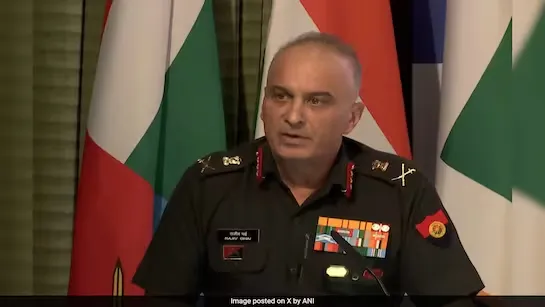
New Delhi — India’s Director General of Military Operations (DGMO) Lt Gen Rajiv Ghai on Tuesday disclosed new details about Operation Sindoor, revealing that the Indian Navy had mobilized into the Arabian Sea and was “ready for action” before Pakistan called for a ceasefire in May.
Speaking at the United Nations Troop Contributing Countries (UNTCC) Chiefs’ Conclave, Lt Gen Ghai described how India’s armed forces had executed a coordinated precision strike campaign in response to the April 22 Pahalgam terror attack, which killed 26 civilians in Jammu and Kashmir.
“The Indian Navy was also very much in action, ladies and gentlemen. This is possibly a fact that is not very well known — that the Navy had sailed into the Arabian Sea, and when the DGMO spoke, it was very well poised,” Lt Gen Ghai said, underscoring the scale of India’s military preparedness.
Operation Sindoor: Decisive Response To Terrorism
Operation Sindoor, conducted between May 6 and May 10, targeted terror infrastructure inside Pakistan and Pakistan-occupied Kashmir (PoK). The offensive was launched after the Pahalgam attack, marking one of India’s most assertive cross-border military responses in recent years.
Lt Gen Ghai warned that if Pakistan had refused to stand down, the outcome would have been disastrous.
“Had the enemy decided to take it any further, it could have been catastrophic for them — not only from the sea but from other dimensions as well,” he said.
He detailed that in the days following the Pahalgam attack, Indian forces were on heightened alert: “Between April 22 and the night of May 6–7, the actions were evolving and unfolding. We were prioritizing our targets and carrying out precautionary deployments to deter the enemy.”
According to Ghai, multiple inter-service departments and intelligence agencies worked in close coordination to ensure the operation’s precision and success.
Information Warfare And Target Selection
Lt Gen Ghai noted that the final selection of strike targets came from a large pool reviewed by the Indian Army. Alongside the kinetic operation, India conducted an “intense and harmonized information warfare campaign” to counter misinformation and shape global perception.
“This was a coordinated national effort,” Ghai emphasized, crediting the synergy between India’s defense forces and intelligence agencies.
India’s Doctrinal Shift Against Terror
Lt Gen Ghai also highlighted a significant doctrinal shift in India’s counter-terrorism strategy, aligned with the vision laid out by Prime Minister Narendra Modi.
“Our Prime Minister has spoken about it,” Ghai said. “Terror attacks are an act of war, and there will be decisive retaliation; we will not succumb to nuclear blackmail; and there is no distinction between terrorists and their sponsors.”
This doctrinal clarity, he added, forms the foundation of India’s new approach — ensuring that acts of terrorism are met with immediate and proportionate military response.
Justice Delivered: Operation Mahadev
In a follow-up to Operation Sindoor, Home Minister Amit Shah informed Parliament in July that security forces had eliminated three terrorists responsible for the Pahalgam massacre during Operation Mahadev.
“The perpetrators of the attack at Pahalgam — the Indian Army chased them to the depths of hell, and we did,” Lt Gen Ghai said. “It took 96 days, but we did not let them rest. When these three were found and eliminated, they appeared exhausted and malnourished. Justice was served.”
Regional Implications
Military analysts note that Operation Sindoor and subsequent operations mark a defining moment in India’s defense posture — signaling to adversaries that any act of terrorism on Indian soil will be met with full-spectrum retaliation.
Lt Gen Ghai’s remarks also underscore India’s growing emphasis on joint operations, maritime readiness, and information warfare as key elements of national security.