By Orlin Milinov
Nearly a decade after his heartbreaking rescue, Hope, the little boy once branded a “witch child” and abandoned by his parents on the streets of Akwa Ibom State, is now a healthy, confident 12-year-old with a passion for art.
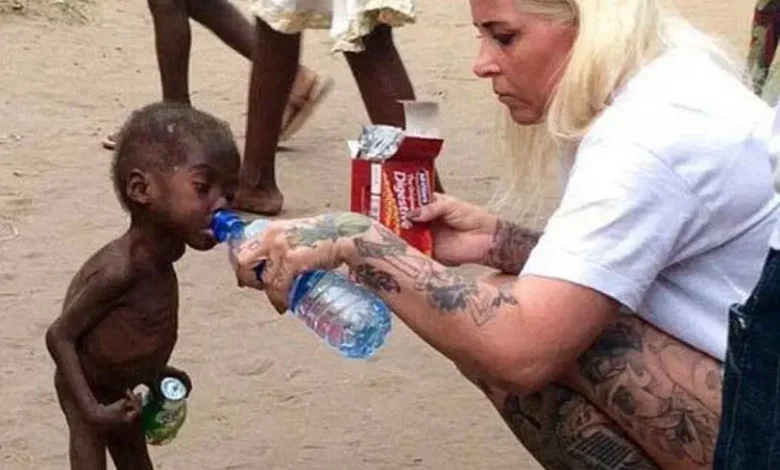
The world first saw Hope’s image in 2016, when Anja Ringgren Lovén, founder of the Danish charity Land of Hope, discovered the severely malnourished boy wandering alone. The photograph of Anja giving the frail child water went viral and drew global attention to the plight of children accused of witchcraft in parts of Nigeria.
At the time of his rescue, Hope weighed just 3.2 kilograms, his ribs visible and his future uncertain.
“When we got to this little boy, he smelled of death,” Anja recalled. “I thought he would die in my arms. We don’t know how he survived, but he did.”
Against all odds, Hope recovered through months of medical care, nutrition, and emotional support at the Land of Hope Children’s Home.
Today, the once-abandoned child is thriving. Although he was later diagnosed as deaf, he communicates through writing and dreams of becoming an artist.
His teachers fondly call him ‘Little Picasso’, a nickname that reflects both his creativity and determination.
“He is now very independent, strong and intelligent – and has lots of friends,” Anja said proudly. “I am so proud that he graduated from school. He was full of pride, and so was I.”
Experts call for stronger action
Child-rights advocates say Hope’s story is a reminder that harmful beliefs still threaten children in many communities.
Leethan Bartholemow, of the International Network Against Witchcraft Accusations and Ritual Attacks, noted that such cases are more widespread than many realise.
“It is much more of a problem than we recognise,” he said. “There is much more work that needs to be done.”
Also speaking, Professor Charlotte Baker of Lancaster University explained that faith-based and witchcraft-related abuses remain a global challenge, not limited to Nigeria.
“Abuse linked to faith or belief occurs across the world,” she said. “They often target children or vulnerable individuals and may result in physical, emotional, or psychological harm.”
According to Baker, these abuses are difficult to detect because they are often hidden within cultural or religious practices.
“Efforts have gone into improving understanding among those who may come across victims of these abuses in their work,” she added.