By Orlin Milinov
Overview
The newest models in the well-liked flagship-killer series, the Xiaomi 15T series, have Leica cameras, huge batteries, premium screens, cutting-edge performance, and classic styling. Today, we’ll examine the Xiaomi 15T Pro, a smartphone that, at least in theory, manages to combine gaming and photography in a really good way.
The Xiaomi 15 Pro is a robust phone with an aluminum frame and a glass sandwich shell. It is rated for up to three meters of submersion and has improved ingress protection.
The phone’s 6.83-inch AMOLED panel, which supports Dolby Vision and HDR10+ content, has a 12-bit color depth, 1280p resolution, and a refresh rate of 144 Hz. There are only 1.5mm bezels surrounding it, and a sheet of Gorilla Glass 7i is placed on top for protection.
The Dimensity 9400+, a former Mediatek champion, and fast UFS 4.1 storage are at the core of the 15T Pro.
Perhaps more than any of its T series predecessors, the upgraded Leica camera setup is more in line with the flagship 15 Pro. The remarkable 50MP Light Fusion sensor (1/1.31″) from OmniVision is still used in the primary camera on the rear. A new 50MP telephoto camera with a 5x optical zoom with a 115mm periscope lens has joined it. The least remarkable feature here is the unaltered 12MP ultrawide camera.
The Xiaomi 15T Pro has a 5,500mAh battery that can be charged at 50W wireless and 90W wired. That’s still more than flagships can provide, but it’s not even close to a record-breaking battery these days.
Additionally, the selfie camera received a little improvement. It has a new 21mm wide-angle lens that lets you fit more in the frame, yet it still has a 32MP Quad-Bayer sensor with fixed focus.
The Xiaomi 15T Pro has a 5,500mAh battery that can be charged at 50W wireless and 90W wired. That’s still more than flagships can provide, but it’s not even close to a record-breaking battery these days.
Summary of the Xiaomi 15T Pro’s specifications:
Body: 162.7×77.9×8.0mm, 210g; 6M13 aluminum alloy; IP68 dust and water resistant (submerged up to 3m for 30 minutes); glass front (Gorilla Glass 7i); aluminum frame; glass fiber back; 330 N/mm frame stiffness; 321 N/mm device rigidity.
Display: Dolby Vision, HDR10+, 68B colors, 144Hz, 3840Hz PWM, 6.83″ AMOLED, resolution of 1280x2772px, 19.49:9 aspect ratio, 447ppi, and Dolby Vision.
Chipset: Immortalis-G925; Mediatek Dimensity 9400+ (3 nm): Octa-core (1×3.3 GHz Cortex-X4 & 4×2.4 GHz Cortex-A720 & 1×3.63 GHz Cortex-X925).
Memory: UFS 4.1; 256GB, 512GB, and 1TB of 12GB RAM.
OS/Software: HyperOS 2 with Android 15.
Wide (primary) rear camera: 50 MP, f/1.6, 23mm, 1/1.31″, 1.2µm, PDAF, OIS; Telephoto: 50 MP, f/3.0, 115mm, PDAF, OIS, 5x optical zoom; Ultra wide angle: 12 MP, f/2.2, 15mm, 120˚, 1/3.06″, 1.12µm.
Front camera: 1/3.44″, 0.64µm, 32 MP, f/2.2, 21mm (wide).
Video capture: Front camera: 4K@30fps, 1080p@30/60fps, HDR10+; rear camera: 8K@30fps, 4K@30/60/120fps, 1080p@30/60/120/240/960fps, gyro-EIS, 10-bit Rec. 2020.
5500mAh battery; 50W wireless, 100% in 56 minutes, 90W wired, PD3.0, QC4.
Connectivity features include BT 6.0, NFC, Wi-Fi 7, eSIM, 5G, and an infrared connector.
Miscellaneous: Circle to Search; dual speakers (with Dolby Atmos); fingerprint reader (optical, under display).
However, the Xiaomi 15T Pro’s €799 starting price is undoubtedly what sets it apart the most. That is significantly undercutting the true flagships, and based on the specifications, it only comes with a few small compromises. To find out if that is true, let’s examine the situation more closely.
Opening the Xiaomi 15T Pro’s package
A thin paper box is used to package the 15T Pro. The phone itself and a USB-A-to-C cable with a 6A rating are its contents.
Another feature that sets the Xiaomi apart from the popular flagships is the dark gray case, which is a welcome bonus. Additionally, a screen protector is pre-installed on the phone.
Design, construction quality, and management
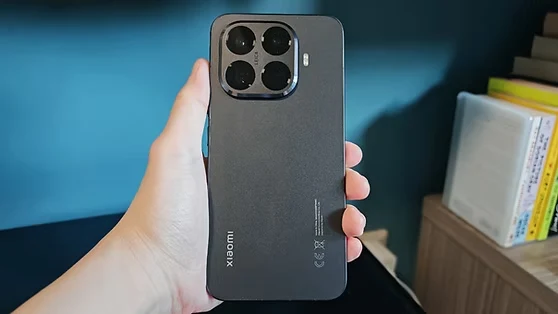
Create, The design language of the Xiaomi 15T Pro is similar to that of the 14T Pro and 13T Pro, although it uses flat front and rear panels and somewhat reworks the square camera housing. The IP68 classification remains the same, but the submersion depth has been raised to 3 meters for 30 minutes. The metal frame is still there. construct quality, handling
With enhanced shatterproofing, the Gorilla Glass 7i front panel is an improvement over the Gorilla Glass 5 seen on the 14T Pro. For even greater drop protection, fiber glass is used for the back. The aluminum frame’s stiffness has been increased from 260 N/mm on the 14T Pro to 330 N/mm.
Smudges and fingerprints are repelled by the matte surface on the back of the frame. All of the side buttons have a little, glossy chamfer, but the camera housing has a larger one. All of these understated details are shiny and provide a stylish, high-end appearance.
There are no sticking parts and all of the lenses on the Xiaomi 15T Pro are flat with the camera island, thus there are no camera rings. We hope Xiaomi has taken this into consideration and made its front lens components sufficiently durable to avoid scratches, even though we undoubtedly prefer this over the previous appearance.
There are three color options for the Xiaomi 15T Pro. We have Mocha Gold, which is perhaps the most intriguing paint job because it doesn’t look overly dramatic or dark. Of course, the Black and Gray alternatives are less interesting.
The huge 6.83-inch AMOLED screen, which has a refresh rate of 144 Hz and a resolution of 1280p, is located in the front. Its 1.5mm bezels are incredibly thin and uniform throughout.
The earpiece serves as the second speaker in the stereo configuration and is located above the screen. There is no proximity sensor here, but there is an ambient-light sensor tucked away. The 15T Pro’s simulated proximity technology has significantly improved and functions nearly as well as a real sensor. Nevertheless, by adjusting the phone’s angle and the surrounding light, we were able to trick it a few times.
Beneath the screen is an optical fingerprint scanner that is dependable and quite quick.
There are four noticeable black rings on the square camera island on the rear. The primary and ultrawide cameras are located in the top row, and adjacent to them is a microphone pinhole. The telephoto lens is located at the bottom, and the color spectrum sensor and infrared blaster are located in the last circle.
The dual-LED flash is located outside the camera island.
The frame is really good; it matches the back in terms of color and polish. The top and left sides of it are uninteresting.
The lock and volume keys are on the right side.
The primary microphone, USB-C connector, dual-SIM tray, and other speaker are located on the bottom.
The Xiaomi 15T Pro weighs 210 grams and has dimensions of 162.7 x 77.9 x 8 mm. It is 2 mm taller and 2 mm wider than the 14T Pro, which is quite little given the 0.15″ larger screen.
A well-made phone with a pleasing appearance and strong ingress protection is the Xiaomi 15T Pro. Although the matte back is quite slick, the overall grip is good, and many people will likely choose to utilize the included case. Yes, we did. You will receive the much-needed grip improvement, but you will lose the lovely hue.
Show
The Xiaomi 15T Pro boasts a sizable 6.83-inch AMOLED screen with a refresh rate of 144 Hz, 1280 x 2772 pixels, and 68B colors. Additional features include support for Dolby Vision and HDR10+ content, 3840Hz PWM dimming, and 480Hz touch sampling.
The Gorilla Glass 7i sheet protects the screen.
The display of the 15T Pro is larger than that of the 14T Pro (6.83″ vs. 6.67″), but it has a lower peak brightness (3,200 nits vs. 4,000 nits).
Without using the sunlight boost (sometimes called extra brightness) option, we measured the maximum manual brightness at 599 nits. The highest manual brightness increased to 826 nits when the boost was used, which is a respectable amount.
At 1,419 nits, the maximum automatic brightness is respectable and an improvement over the 14T Pro. With a smaller portion of the display illuminated, it may reach over 3000 nits.


